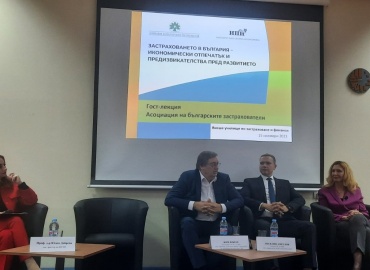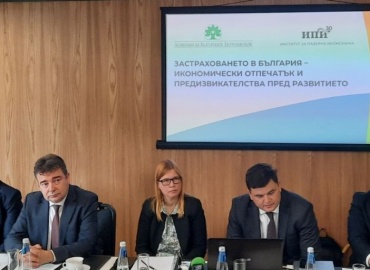

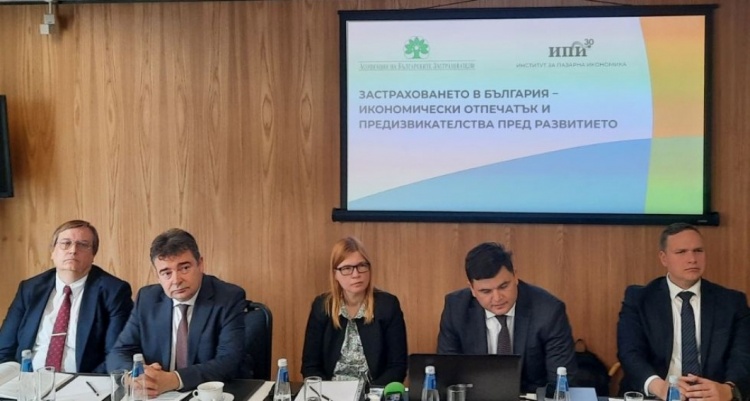
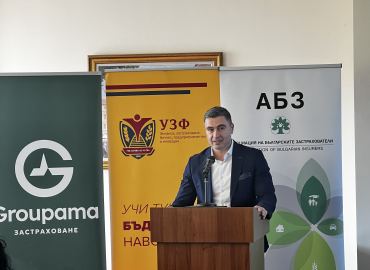
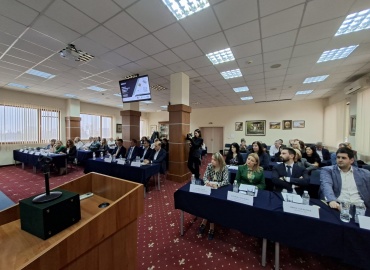
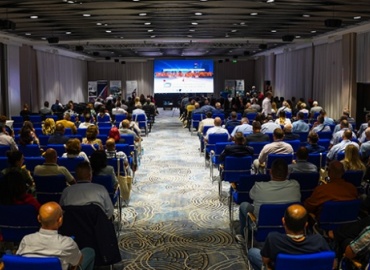
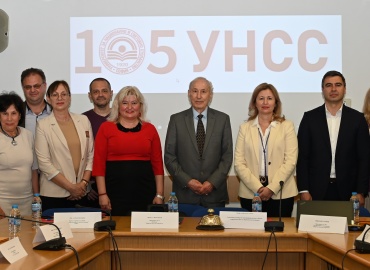
On 11 May 2023, the analytical report "Insurance in Bulgaria – Economic Footprint and Development Challenges", prepared by the Institute for Market Economics (IME) for the Association of Bulgarian Insurers (ABI), was publicly presented. The discussion event featured contributions by Konstantin Velev, Chair of the ABI Management Board, Yuri Kopach, Deputy Chair of the ABI Management Board, Veselin Angelov, Member of the ABI Management Board, Lachezar Bogdanov, Chief Economist at IME, and Petya Georgieva, Economist at IME. The event was attended by representatives of academia, the insurance community, state institutions, and media.
"Such a comprehensive and insightful study is being carried out for the first time in Bulgaria with regard to the insurance sector. We believe it will not only stimulate public discussion on the multifaceted contribution of the insurance industry but also serve as a basis for generating ideas and policies to unlock the sector's untapped potential for public benefit," commented Konstantin Velev at the opening of the discussion. He added that the need for an independent and impartial assessment of the sector was the reason why the study was commissioned to IME. Yuri Kopach emphasized that behind the sector's economic and societal contribution lie the hard work and dedication of all insurance professionals.
Lachezar Bogdanov and Petya Georgieva presented the key findings and conclusions of the analytical document.
According to Lachezar Bogdanov, despite the sector's upward development, it still lags behind other European markets. The share of total premium income in GDP, expressed through the "insurance penetration" ratio, ranges from 2 to 2.4% over the years, while the European average is 7.4%. These figures clearly outline the boundaries of the unrealized potential of the Bulgarian market.
The Bulgarian insurance market significantly differs from other European markets in terms of structure, with a strong dominance of motor insurance, primarily mandatory motor third-party liability (MTPL), and comparatively low coverage in other lines of business. This imbalance impacts the overall effects of insurance activity and is largely the result of regulatory decisions, suggesting that solutions should also come through regulatory channels, Bogdanov commented.
Motor insurance (MTPL and casco) holds the dominant share of premium income—70.9% in 2021. Property insurance, excluding motor and general liability, generates only 13.8% of premiums. In countries with highly developed property insurance markets, the share reaches close to 50% of total premiums, with a European average of 36.5% according to Insurance Europe.
In 2021, claims from MTPL and casco accounted for more than 84% of all claims in non-life insurance and 69% of total insurance payouts. Non-life insurance accounted for 81.8% of all claims paid in 2021. Claims related to fire and natural disasters approached BGN 65 million (5% of the sector total), while those related to illness amounted to BGN 48 million (3.7%), reaching BGN 84 million or 6.5% of total claims when combined with similar life insurance products.
The economic impact of insurance is most directly illustrated through the amount of claims paid. These enable the preservation of consumption levels or the quick replacement of durable goods and assets, essentially translating into effective market demand for goods and services. The dynamics of paid claims largely follow the increase in gross premium income. From 2008 to 2021, total payouts increased from BGN 688 million to BGN 1.297 billion, reflecting a 79% growth in non-life and 151% in life insurance.
From 2015 to 2021, the total amount of claims closely tracked overall economic activity, with the claims-to-GDP ratio holding steady at around 1%. For comparison, this figure ranges from 1.2% to 1.8% in many Eastern European countries, 3% to 6% in Western Europe, and over 8% in Scandinavia. Bulgaria remains among the countries with the lowest insurance payouts relative to GDP, indicating underutilization of risk transfer mechanisms. Consequently, the financial burden of recovery from adverse events often falls on the state budget, businesses, and households.
Insurance companies’ investments represent another significant aspect of the sector's economic impact. Though not leading, insurers are important institutional investors, Bogdanov noted. Enhancing this role requires adequate regulatory incentives in life insurance, as these products support accumulation, savings, and investment. Globally, life insurers are among the largest institutional investors.
On average over the last decade, insurance investments accounted for 3.5% to 4% of GDP. The structure of investments is shifting, with the share of deposits decreasing. Over BGN 2.1 billion is invested in government bonds. As of end-2021, Bulgarian insurers held BGN 502 million in internationally issued Bulgarian government bonds and BGN 887 million in domestic ones. Insurers financed 10.4% of domestic and 2.8% of international bond issues.
Insurance activity also leaves a broader economic footprint through related and supporting industries. According to IME's estimate, the combined effect of insurers' activities generates additional demand of over BGN 1.1 billion.
The sector also contributes through road safety initiatives, agricultural support, and corporate social responsibility efforts.
Petya Georgieva emphasized the significant impact of public policies and regulation on sector development. The sector's fiscal contribution is traceable via taxes paid. In 2019, corporate tax revenues from insurers rose by nearly 45% to BGN 71 million. The insurance premium tax has been rising steadily since 2013, reaching almost BGN 47 million in 2020. Although relatively low as a share of total tax revenues, these are closely tied to the scope and performance of the insurance sector.
Another important form of state involvement is mandatory insurance. Bulgaria mandates insurance for certain professions, public sector employees, property, and liability. The MTPL segment leads among mandatory insurance products. However, the effectiveness of mandatory insurance is limited and depends on enforcement. Petya Georgieva cited the low coverage of municipal property as an example.
IME economists also criticized the state's tendency to signal post-disaster compensation for citizens, which creates negative incentives and discourages adequate insurance coverage.
Petya Georgieva identified several areas with untapped potential for insurance expansion that could enhance social welfare. One is climate change, which heightens the need for better use of property insurance mechanisms. Healthcare is another area where insurance can offer viable solutions. Currently, voluntary health insurance primarily covers outpatient care, due to the structure of Bulgaria’s healthcare system, the broad coverage by the National Health Insurance Fund (NHIF), and the lack of a market niche for health insurers.
Cyber risks related to digitalization represent a growing field for insurance solutions. There is also significant potential in life insurance, particularly in light of demographic risks and the need for individuals to take greater responsibility for retirement security beyond the mandatory public system.
The ensuing discussion addressed various issues, including the underutilization of insurance mechanisms for both property and social protection.

-370x270-1.png "News image")

























-370x270-1.png "News image")