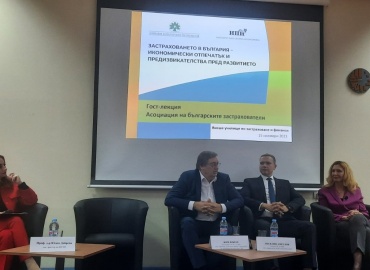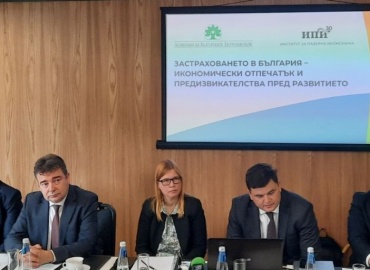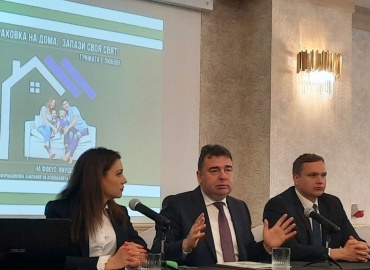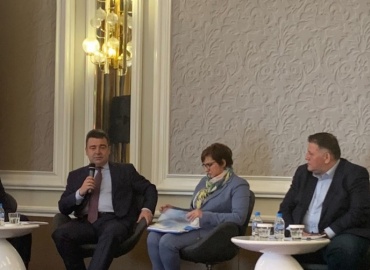


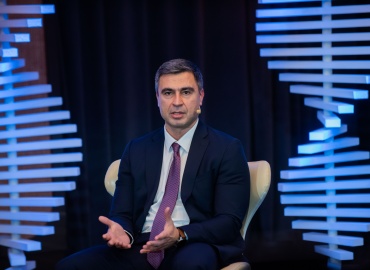
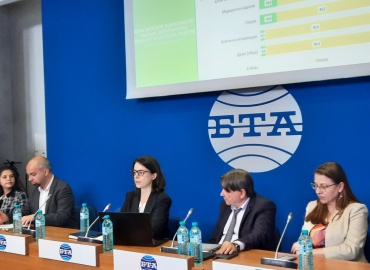
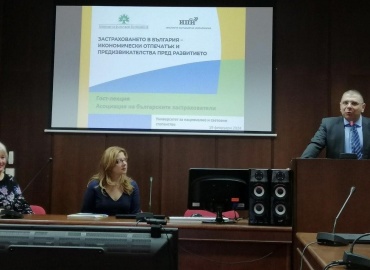
What has been the development of the insurance market over the years and how does it contribute to investment, income, and the economy? These were among the key questions addressed during the special edition of the economic and current affairs program Money.bg. The episode titled “Insurance: Reality and Opportunities” aired on Bulgaria ON AIR on 20 May, moderated by financial journalist Petar Iliev, part of the Money.bg team.
Konstantin Velev opened the discussion by highlighting the consistent upward trend in the insurance market in recent years. He noted that the pandemic years and the war in Ukraine, along with the ensuing crises, have had a less negative impact on the insurance sector compared to other industries. In 2022, the market grew by just over 10%. Motor third-party liability insurance remained stable with no significant expansion in the client base. However, Casco motor insurance premiums grew by over 15%, accompanied by a 5% increase in clients. Life insurance grew by around 3%, and property insurance by about 9%, although starting from a low base. According to Velev, natural disasters lead only to temporary spikes in interest in property insurance, without fundamentally changing the market. In Bulgaria, over 82% of people live in owned homes, yet tend to invest less in protecting their property. He stressed that property insurance remains affordable and does not burden family budgets. He also emphasized the importance of customers being well-informed about the risks covered and the limits of their home insurance policies to avoid unrealistic expectations in case of claims.
Veselin Angelov, member of the ABZ Management Board, stressed the role of insurance in ensuring the country’s economic stability. He noted that low insurance penetration in Bulgaria indicates untapped potential. Despite broad and easy access to insurance services across the country, various factors affect the consumption of insurance products. One such factor is the persistence of negative myths that are easily disproven by facts. “One of these myths is that insurers don’t pay claims. In reality, only 3-5% of submitted claims face issues, and mainly due to uncovered risks,” said Angelov. “Another myth is that the state will always provide aid after natural disasters. But that’s not always true, and even when aid is granted, it is often insufficient to truly get people back on their feet. Only insurance can provide that level of protection,” he added. Angelov emphasized that the industry is actively working to raise public awareness and improve insurance literacy. He also called attention to emerging risks such as climate change, health, demographic shifts, and digital risks, all of which present growth opportunities for the insurance sector.
Lachezar Bogdanov, Chief Economist at the Institute for Market Economics, pointed out that despite the sector’s upward trend, there remains a major gap with Western Europe: insurance penetration in Bulgaria is two to three times lower. He explained that insurance grows in tandem with economic and investment activity. Insurers are key investors, employing thousands of people. Their investments have averaged around 4% of GDP over the past decade. The structure of those investments is also changing, with a shift away from bank deposits towards more diverse investments reinjected into the Bulgarian economy. Bogdanov also highlighted a worrying trend: despite a legal obligation for the state and municipalities to insure certain assets, this requirement is often ignored. Fires, floods, and landslides are the most common natural disasters in Bulgaria, costing the state about BGN 80 million annually, with some years exceeding BGN 440 million. “Ultimately, these funds come from taxpayers,” Bogdanov concluded, “and we must ask whether that risk should be shared with insurers.”
Maria Veleva, General Manager of ZB Balkan, underlined the critical role of insurance intermediaries. They help bridge the gap between client needs and available insurance solutions, guiding people toward appropriate contracts and insurance products. She emphasized that clients must understand the specifics of their coverage and actively ask questions. Insurers, she noted, invest heavily in improving customer interaction. On the topic of affordability, Veleva shared that full property insurance for an apartment in major cities like Sofia, Varna, Burgas, and Plovdiv ranges between BGN 150-180. In smaller towns, the price is between BGN 80 and 150. “Casco insurance premiums are significantly higher,” she pointed out. “We should consider what would be more devastating to lose – our car or our home.” Most people can afford home insurance, but don’t purchase it. Veleva concluded: “It is the insurer’s responsibility to earn their trust, explain the benefits, and dispel any doubts.”
-370x270-1.png "News image")
















-370x270-1.png "News image")